Published July 3, 2026 · Updated July 5, 2026
Dehydrated Garlic Products: Flakes, Granules, Powder. A Specification Guide for Food Manufacturers
A specification reference for food manufacturers buying dehydrated garlic: mesh sizes, moisture content, shelf life, and quality parameters that matter.
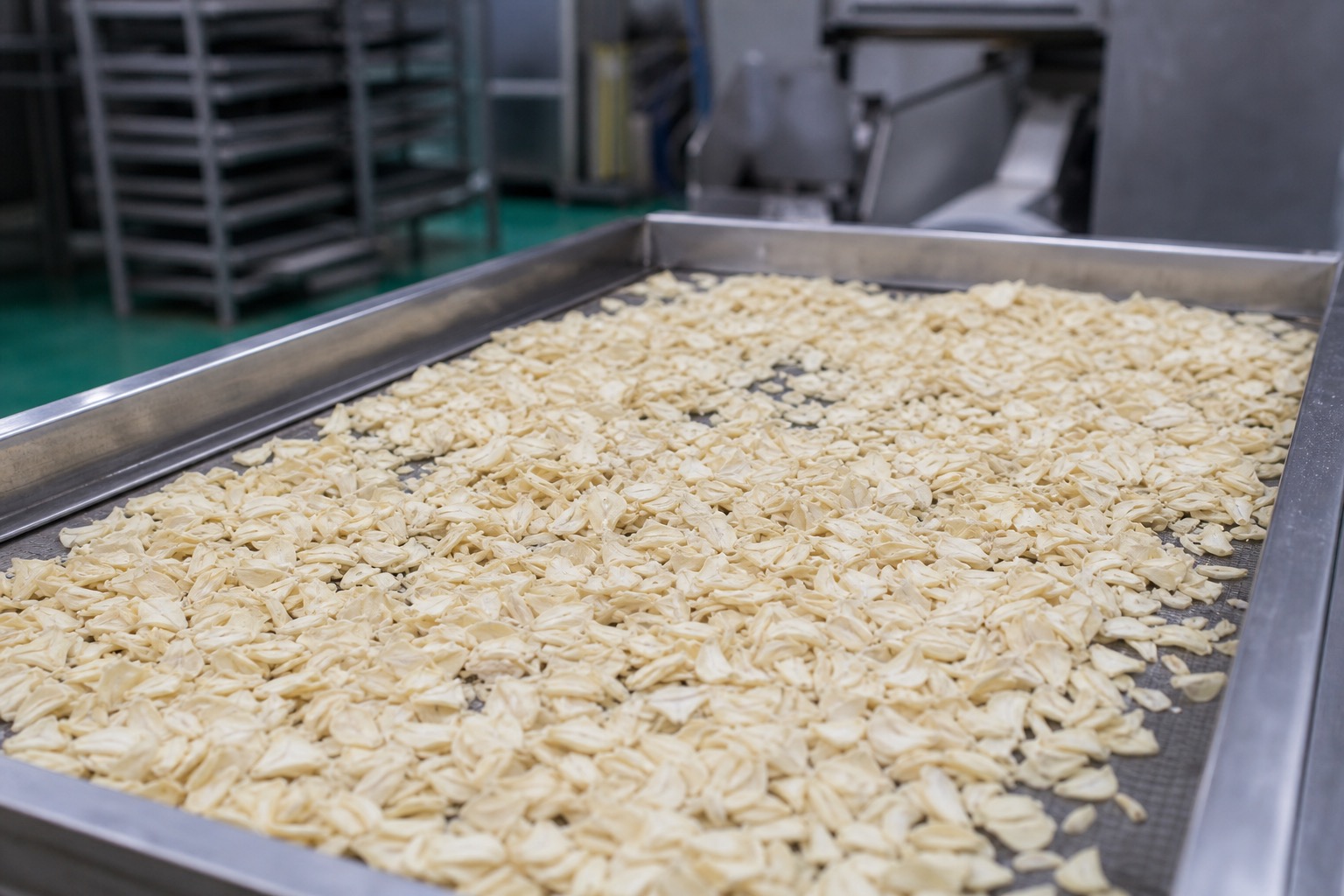
📷 Dehydrated garlic flakes, factory
/images/product-garlic-flakes.jpg
Dehydrated garlic reaches your line in one of three physical forms: flakes, granules, or powder. Each form is defined by a small set of measurable parameters, and a purchase contract that names those parameters exactly is the difference between a lot that runs and a lot that gets rejected. This guide decodes the dehydrated garlic specification sheet so a food manufacturer can write a tight order. All the products described here are sourced through us as dehydrated garlic from certified Jinxiang processing plants.
The AD Process and Why It Fixes the Base Specs
Air-dried (AD) production starts with fresh raw material. Peeled cloves are sliced, then dried in controlled airflow until moisture falls below 6%. Every downstream form shares that same dried base, so the moisture ceiling, shelf life, and flavor profile carry across flakes, granules, and powder. Granules and powder are milled from dried flakes, which means the size grade you order is a milling and sieving decision made after drying. Because the raw bulbs come from the same growing region as our fresh garlic, color and pungency stay consistent from crop year to crop year.
Product Forms and the Spec That Defines Each
Match the form to how the garlic behaves in your finished product. Flakes stay visible and rehydrate on contact with liquid. Granules meter cleanly through automated dosing equipment and hold their shape in a dry blend. Powder disperses fastest and releases flavor in wet applications such as sauces and marinades.
Flakes and Slices
Flakes are whole dried slices available in several thicknesses. They are the highest-volume dehydrated format and the base material for granules and powder. Specify thickness, color grade, and target market on the order. Typical buyers are seasoning blenders, instant noodle producers, and snack manufacturers.
Granules
Granules are milled and sieved into four standard mesh cuts: 8-16, 16-26, 26-40, and 40-60. A lower mesh number is a coarser particle. Coarser cuts stay visible in a finished blend; finer cuts distribute more evenly and hide in a formulation. Free-flowing granules run reliably on industrial dosing and blending lines.
Powder, Standard and Soluble
Standard garlic powder is ground to 80-120 mesh. It is the most specification-sensitive dehydrated product because fineness, color, and microbiological limits all move together at that particle size. A soluble grade is available for clear liquid systems. Powder goes into sauces, marinades, seasoning sachets, and pharmaceutical preparations. Confirm mesh, color, and micro limits in writing before production starts.
Crumbles and Fried Flakes
Fried or toasted formats are finished, ready-to-use products rather than raw dehydrated material. Crumbles are irregular fried pieces used as a food-service topping. Fried flakes are whole slices crisped in oil and sold as a retail or food-service garnish. Oil quality and color consistency are the parameters to lock down on these two.
Reading the Spec Sheet: Form, Mesh, Moisture, Shelf Life
The table below is the core of any dehydrated garlic purchase contract. Copy the row for your chosen form into your specification and add your color grade and microbiological limits. Moisture below 6% and shelf life up to 6 years hold across all raw dehydrated forms.
| Form | Mesh / Cut Size | Moisture | Shelf Life | Typical Applications |
|---|---|---|---|---|
| Flakes / Slices | Whole slices, multiple thicknesses | Below 6% | Up to 6 years | Seasoning blends, instant noodles, snack foods |
| Granules | 8-16, 16-26, 26-40, 40-60 mesh | Below 6% | Up to 6 years | Spice blends, dry mixes, industrial food manufacturing |
| Powder | 80-120 mesh (soluble grade available) | Below 6% | Up to 6 years | Sauces, marinades, seasoning sachets, pharmaceutical uses |
Color and flavor are graded alongside the physical specs. Buyers typically call for a clean off-white to light-cream color with no scorching, and a fresh, pungent garlic aroma free of any burnt or fermented note. State an acceptable color range and note whether you need low-heat processing, since drying temperature drives both color and residual pungency.
Microbiological Parameters Buyers Should Specify
Dehydrated garlic is a low-moisture ingredient, so the microbiological limits are the parameters most likely to fail an incoming inspection if left unstated. Name them explicitly on the purchase order rather than assuming a plant default.
- Total plate count: set a maximum, commonly expressed in colony-forming units per gram. Milled powder generally carries a higher count than flakes because of surface area, so specify a limit appropriate to the form.
- Coliforms: set a maximum count. This is a routine hygiene indicator for dried spice-class ingredients.
- Salmonella: specify negative in the tested sample size. Most food-safety programs treat any detection as a rejection.
- Yeast and mold: set a maximum where your finished product or destination market requires it.
We arrange third-party laboratory testing on request through SGS, CCIC, Bureau Veritas, or Intertek, and we verify each lot against the agreed sheet before the container is sealed. The full inspection and export workflow is documented on our supply chain page.
Packaging, Storage, and Certifications
Standard export packing is kraft bags and cartons, with bulk formats for high-volume industrial buyers. Custom packaging and private-label programs run through the same partner plants. Dehydrated garlic ships in 40-foot dry containers and needs no cold chain, which keeps freight simple compared with fresh product.
Shelf life reaches up to 6 years when moisture is held below 6% and the product is stored cool, dry, and away from direct light. Reseal opened bags promptly, because dehydrated garlic is hygroscopic and will pick up ambient moisture. We confirm production date and remaining shelf life on every lot before it leaves Jinxiang.
For certifications, HACCP, BRC, ISO 22000, Kosher, and Halal are available. Certification is a plant attribute, so the right approach is to match the order to a facility that already holds what your importers and retailers require. Tell us your destination market and product form, and we select the plant, confirm the full specification, and inspect the lot on your behalf.
Send your target form, mesh size, moisture ceiling, microbiological limits, certification requirements, quantity, and destination port, and we reply within 24 hours with a wholesale quotation from a certified plant. Start with a product enquiry or review the full dehydrated garlic range.